By: Jim Aust
Reprint from Rod & Custom Magazine, September 2005
 s our favorite antique vehicles become more and more valuable, the temptation to cut up the really nice survivors and restored examples becomes more and more difficult. Thankfully problem-solving companies like Gear Vendors makes these tough decisions easier with products not only designed to fit in older vehicles, but also to make the cars a great deal more enjoyable to drive.
Already well-known and respected for their bullet-proof overdrive units for motor homes, dualies and muscle cars, Gear Vendors turned their attention to providing a unit for classic cars equipped with torque tubes. Originally intended and installed in large ’20s and ’30s luxury cars such as Rolls Royces and Cadillacs, it wasn’t long before the units were adapted to early Fords. Today there are plenty of reasons why you would want an overdrive under your classic or hot rod (gas prices being one of them), and Gear Vendors has made the conversions for early vehicles easier than ever.
The root of the Gear Vendors’ product is the DeNormaville design overdrive that first became popular in early European imports. But the early Laycock/DeNormanivile units had their weak points and could be damaged. Using the same patents but with larger and stronger components, the Gear Vendors
units have addressed all the problems associated with the early units with numerous upgrades that make them nearly indestructible and can be operated on a 6- or 12-volt system providing hundreds of thousands of reliable miles.
The unit Gear Vendors provided to the restoration and hot rod market is the same unit used in muscle cars, drag racing, and off-road racing with up to 1,200 hp, with the only change being a simple hydraulic pressure drop to make smooth clutchless shifting nice on the early iron (the racer wants the firm shifts of the higher pressure). Clutchless shifts are a personal preference, but controlling a shift with just a button is always nice.
While the cost of the Gear Vendors unit may be a concern, when you start to add up the benefits—bulletproof overdrive, 25 percent better fuel economy (typical), 28.6 faster road speeds, great reductions in engine noise, wear, temperature, fewer valve adjustments, and just more pleasure driving—it becomes a great bargain. Gear Vendors kit come with a 30-day money bac-back guarantee and all products for the restoration cars come with a two-year unlimited mileage warranty and the best customer service on the planet.
Page Two
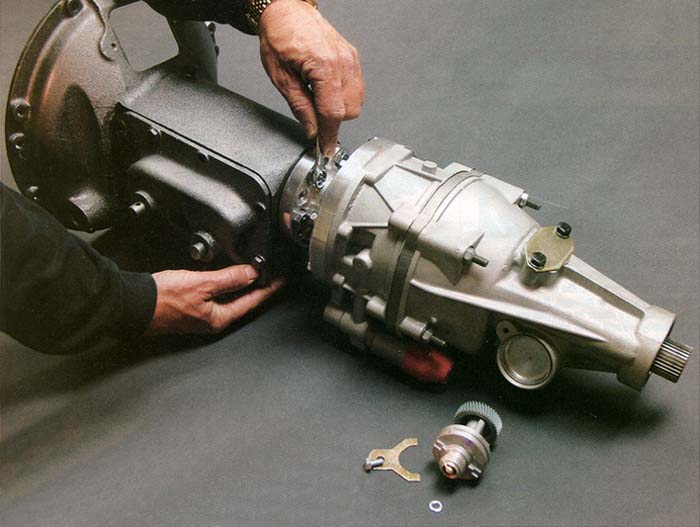
The ’40 Ford transmission (and all similarly mounted early Ford closed-drive transmissions) is one of the latest units Gear Vendors has developed and adaptor for. The Gear Vendors unit not only improves mileage, it better utilizes the engine’s power by splitting the gears. By mounting the unit to the back of the transmission the added benefit of converting it to open-drive is gained.
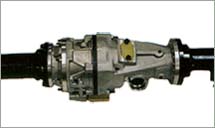
For those who wish to retain the torque tube Gear Vendors offers a kit to integrate it within any vehicle equipped (Buick, Cadillac, Packard, etc.) with a torque tube. They will supply you with directions to install it or they can make the modifications if you send them your torque tube and shaft. The kit comes with weld-on flanges and couples so, once installed, the overdrive simply bolts in.
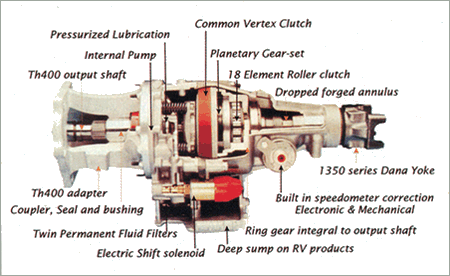
Roy Brizio, Troy Trepanier, and Jack Chisenhall are just a few of the familiar names that have long been associated with the Gear Vendors product. With over 50,000 units sold in the last 25 years, you will not find a better engineered product – that is why all of GM’s Twin Turbo Callaway Corvettes came factory with a Turbo 400 and a Gear Vendors Under/Overdrive.
Why Split Gears?
While most people think of the Gear Vendors unit as a bolt-on overdrive, its main purpose is to effectively double the number of gears in the transmission by splitting the distance between every gear. This allows you to start off in First, but instead of shifting directly to Second, you have the option to flick the switch and split the gear to First-over without activating the clutch. This system lets you better use the power of your engine with minimal loss between the original widely spaced gears—your old three-speed now becomes a close-ratio six-speed.
What the Gear Vendors unit in fact accomplishes, with the wide ratios of the early Ford manual transmissions for example, is to give you the low First gear necessary to get the lower revving old cars rolling and then once the Under/Overdrive unit kicks in, you get the gearing nearly identical to a
Page Three
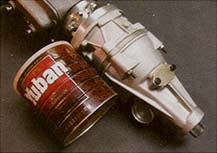
A great visual and physical representation of the actual size of a Gear Vendors unit is a standard large coffee can. Matching the coffee can to your vehicle’s centerline, you can get a very accurate idea of how much (or how little) room is required to fit the unit to your vehicle.
Muncie M21 (close ratio) box that most rodders will be familiar with. Where the Ford box would have a 2.82 First gear followed by a 1.60 Second, it is now “split” by a 2.20 gear when activating the First-over in the Gear Vendors unit. As you continue to accelerate and shift to Second, flick the unit off for Second-direct. As the engine builds power, hit the Gear Vendors control again and feel the smooth power transfer into 1.25 Second-over. After the 1.00 Third gear, the units provide an engine-saving 0.78 final overdrive.
Other Early Overdrive Options Other options for early overdrives exist, but as we found out from driveline expert Dave Enmark, these antique pieces definitely have their limitations. The first option would be the vintage Borg-Warner and similar units that were produced to bolt on to many different early transmissions. The first drawback to these units would be the size that adds, on average, an additional 18 inches to the
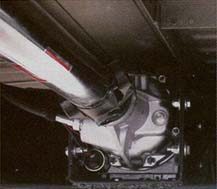
This early Cadillac eliminates the closed drive-line with a Gear Vendors unit “Cradle” mounted behind the factory crossmember in the frame.
transmission, but also parts-availability and ability to handle limited amounts of horsepower puts this unit way down on the list of choices.
Another option for Ford fans is the Columbia two-speed rear axle, Enmark is quick to point out “these rear ends are old and can’t take the power of later engines.” He also states that this style of rear does not accept stronger late-model axles and the cost of rare and hard-to-find original controls and expensive rebuilds puts them well into the budget stratosphere. Anything beyond a mildly built early engine is not suggested for either the early overdrives transmissions or the two-speed Columbia axles.
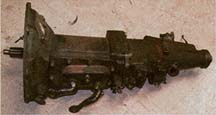
This ’50 Mercury transmission is equipped with an original Borg-Warner over drive unit. The down-sides to this style of overdrive are that the unit adds a bulky additional18 inches to the transmission and the antique parts originally used were not designed for the kind of power today’s engines make.
The Columbia two-speed rearend was an early attempt at splitting the gears and offering a
user-friendly final overdrive gearing. Prices to rebuild these units, parts availability, and low strength make this a poor choice for anything but a restored classic.
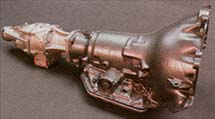
If you look closely you’ll notice that the basic unit bolted to this Turbo 350 is the same as the ones we’ve been talking about. The Gear Vendors units might not be the cheapest alternative, but if you ever want to sell your car and take the unit with you, it can be installed on another trans with just a new adapter.