
By:Matt Emery
Photography: Matt Emery
Reprint from Truck Builder Magazine, August 2004
 s a supplier of GM’s famed Callaway Twin Turbo Corvettes in the ’90s, Gear Vendors developed some significant relationships with the GM folks. It was due to their working with GM on the C5 Corvette project that Gear Vendors thought that there had to be a better way to engage and disengage their system than strictly by a manual mode.
Up until now, although the device itself was not limited to do so, many a Gear Vendors Under/Overdrive unit was really only used as an overdrive, and most of those who owned them didn’t understand the unit well enough and consequently under-utilized the ability of the unit. The unit actually gives the driver the ability to pick the right gear for any given situation, if applied as such. But due more to misunderstanding, the true value of a Gear Vendors, unit has never been fully appreciated.
There are those who are more performance-minded, who could see the value and potential, so they incorporated this unit in high-
horsepower applications where they could take advantage of not only the gear splitting capability of the unit, but also the manual gearing advantages that the Gear Vendors unit provides. Consequently, in these applications, a lower rear gear can be utilized, and the much-improved gear split of the Gear Vendors unit utilized, along with its overdrive capability for highway cruising capability. And, when spirited performance is not needed, the gear selection can be “overdriven”; thus all the brut power can simple be idled about. It’s like having the best of both worlds, and those who have incorporated this unit in this manner have a great deal more flexibility built in!
To that end, and to further the broad utilization of the Gear Vendors Under/Overdrive unit, they are about to release a group of electronic options that will automate the operation of their Under/Overdrive unit. This means that you can now rocket through all 8 gears, if you have a 4-speed automatic such a 4L60E, or 6 gears, if you have an older
350 or 400 Turbo, and never again have to “time” turning off the unit to get from one ratio to another.
Calling the new system the AutoOut, Gear Vendors has nearly taken the driver out of the system. With our extensive experience with this unit, this is a good thing for those who would like to take advantage of all that this unit offers, but simply didn’t understand how to do it. By reading the input speed, a well as the output speed from the Under/Overdrive unit (as well as which gear the transmission is in, of course), the system will engage and disengage the Gear Vendors unit by itself. This makes the use of the Gear Vendors system so much easier than ever before, and we liked it as it was. We have, however, always thought how slick it would be to turn the GV unit into one that could be operated with steering wheel paddles; that would be trick. While this isn’t quite that system just yet, it’s a close alternative, as it does the work for you.
Page Two

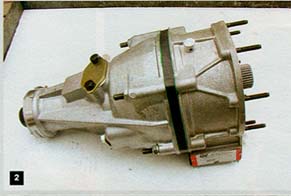

2 Though not new, the Gear Vendors under/overdrive unit is tough. They are rated to handle huge torque numbers, and are the best thing to happen to manual transmissions since the ratchet shifter.
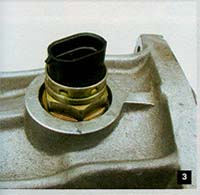
3 This lead is on the new GV section, and will read the output shaft speed of the transmission. This lead will go to the buffer box.
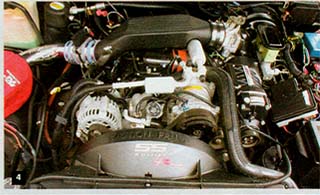
4 The truck that will receive the new GV unit is a ’96 Chevy. It is powered by a 350ci engine that is now equipped with a Whippie supercharger. It has a 4L60E transmission.
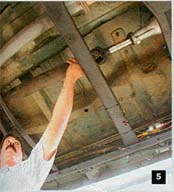
5 The first step is to remove the driveshaft. It is a two-piece unit that will have to be shortened. Actually both halves will have to be shortened.
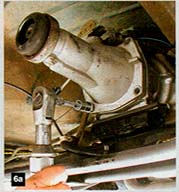
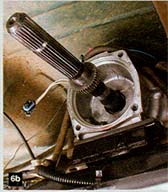
6A-B With the removal of only four bolts, the tail housing can be removed, but have a pan handy as a small portion of fluid will be lost.
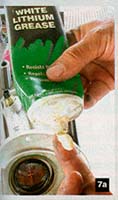
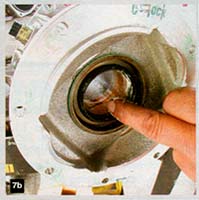
7A-B Before the new GV tail housing unit can be installed, a dab of white lithium grease is placed on the bushing.
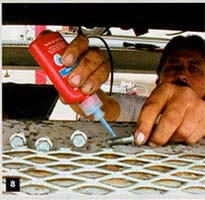
8 A few drops of Loctite are applied to the bolts in preparation of their installation.
9 Care is taken when installing the tail section so there is no damage to the splines on the output shaft.
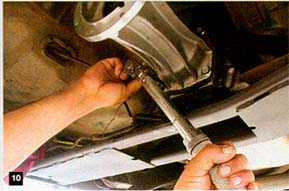
10 A torque wrench is used to ensure that the mounting bolts are at a steady 18lb-ft.
Page Three
Gear Vendors plans to market these AutoOut electronics as an optional feature, because though they are really nice, they are just part of the whole performance gear splitting package. Rick Johnson told us that it’s due to the fact that the existing standard electronics package is made in such volume, it comes out to be only about $150 dollars of the $2,300 (average) cost of a Gear Vendors overdrive kit. Then he says that though the “AutoOut” electronics costs him nearly three times the cost of the standard electronics, the option will be available at a cost of only $350, when purchased with a new kit. For those who would
like to retrofit an AutoOut to their existing system, the price will be $450. Either way, it’s a very smart investment, as the new electronics really makes the Gear Vendors Under/Overdrive system come alive.
Speaking of switches, Gear Vendors makes a variety of them to activate the overdrive. They have cool billet rockers for floor-mounted shifters, a micro switch designed to fit inside the top or side of T-handles, balls and pistol grips. In the case of this Chevy, the owner will eventually use a B&M floor shifter with a T-handle, but the truck currently has the stock column shifter, so the GV control switch is a foot-
operated switch just like a headlight dimmer switch. This switch is part of the GV kit. By toe tapping the button, another gear is there any moment you want it.
The truck that will receive the new Gear Vendors upgrade is a sweet extended cab, long bed ’96 Chevy 1500 owned by Victor Scalco of San Diego, California. Scalco owns an automotive detailing business, so he works on some seriously fancy rides. He decided he needed a Gear Vendors unit because sometimes he needs to pick up and deliver the cars, so his truck needs to be able to tow his long trailer, and he wanted his pickup to be
Page Four
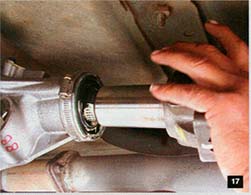
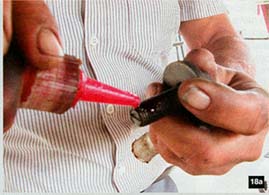
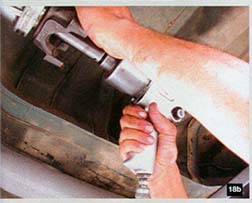
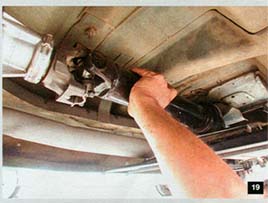
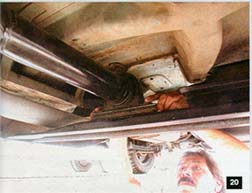
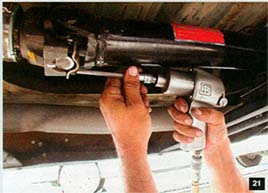
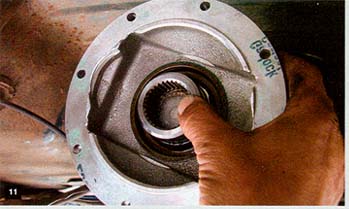
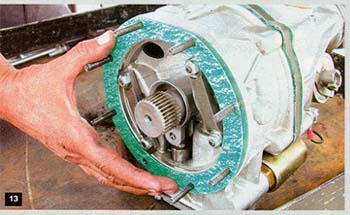
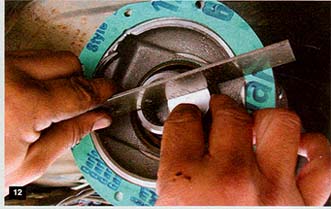
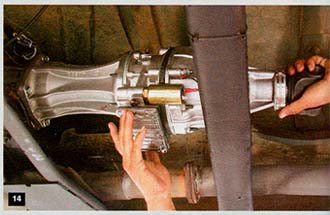
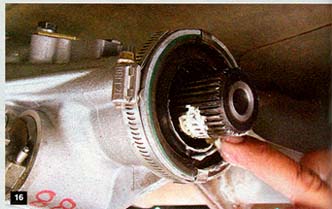
11 This center bushing slips over the output shaft. 12 It is very important that this bushing is exactly even with the tail housing, and a straight edge is used to get this right. Shims placed behind the bushing are used to do this, but note that the measurements are taken with the gasket in place. 13 With the mounting posts installed into the GV unit as well as the gasket, the unit is ready to install. 14 The GV Under/Overdrive unit is slipped into place. 15 Once all of the nuts are on tightly, they are torqued to 8lb-ft. 16 White lithium grease is placed on the splines of the output shaft. 17 And the GV yoke is installed. 18A-B A few drops of Loctite are placed on the bolt which hold the yoke, and a pneumatic impact gun is used to tighten it down. 19 With the two sections of the driveshaft cut to length, the first section is installed. 20 As this is a lowered truck, shims are placed beneath the carrier bearing to get the proper angle on the driveshaft. 21 After Loctite has been added to the treads of the U-joint, the hardware is tightened up.

 hen the Gear Vendors unit was in the truck and the last bolt tightened, Rick Johnson, owner of Gear Vendors, asked if we wanted to take a ride with him so I could see firsthand how the new AutoOut electronics worked. Sure, we said.
If you remember the first Cheech and Chong movie, the two meet when Chong is hitchhiking and Cheech stops and gives him a ride. Once Chong is seated, Cheech proceeds to smoke them off the line (no pun intended) and much to Chong’s alarm, bangs up through the gears with his foot planted on the accelerator. After reaching top gear and screaming down the road, Cheech looks over and ask Chong where he want to be left off. They haven’t traveled half a mile, yet his immediate reply is “uh, right here would be fine, man”. That is kinda like going for a ride with Johnson. He launches the truck with the gear selection in the 1 position. The truck is in of course, 1st gear, but without the GV on, and the truck shifts to 2nd gear. We are already going
ticket getting speeds, so he slows down and the truck shifts up to 3rd. This is the normal scenario for any automatic. One thing about this type of trans is that even with the gear selector in 1, the transmission will still shift up to 2nd. Odd. Anyway, the problem is that the gaps are too wide to grab anything but one or two gears if you let the engine rev out.
Next time Mr. Johnson launches in 1st gear, but this time he hits the dimmer switch. With the AutoOut controlled Gear Vendors unit activated, it steps up the shift points electronically. So, the truck revs out in 1st gear, shifts to 1st over, revs up and then upshifts to 2nd direct by itself. This scenario repeats as he revs out 2nd gear and the GV unit shifts up to 2nd over. Since the engine was in its torque range, it barked the tires on all three shifts and kept the boost in the fat part of the curve. With (seemingly) all these gears, the truck takes on a whole new personality and is just plain fun to drive. The new AutoOut electronics definitely add to the enjoyment by managing the “outshifts” automatically.
Page Five
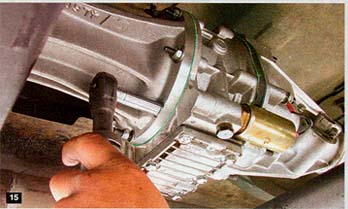
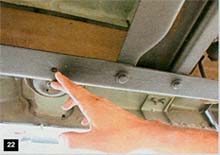
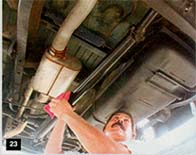
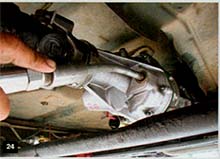
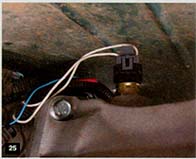
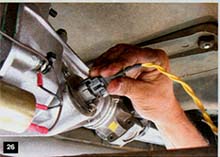
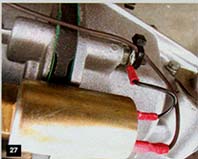
22 One note: Due to the additional length of the GV unit, it was decided to move the mount for the carrier bearing back from its original position (the finger indicates the stock forward mounting position). This is because it was felt that the front section of the driveshaft would have been too short (less than 12inches) if it was cut to fit into the original mounting position. The original rearward-mounting hole became the front mounting hole, and a new hole was drilled in the frame for the rear mount. 23 The shortened rear section of driveshaft is slipped into the carrier bearing and affixed to the rearend.24 The GV unit is filled with fluid. 25 The stock speed sensor is plugged into the new GV tail housing. This will read the output speed of the vehicle, as well as the input speed of the GV unit. 26 This speed sensor on the GV unit will read output speed after the unit. This lead is run to the new GV electronics. 27 Also coming from the GV electronics is the lead that controls the solenoid. This is what engages and disengages the GV unit. The second lead is a ground lead.
up to the challenge. Nicely appointed in electron blue with white pearl racing stripes, it is of course lowered, and a Whipple forced induction unit now pumps up the 5.7L TPI engine. Combining the low gear of the stock trans with the 3.73:1 rear gears means that he can leave the line in a hurry, but the wide gear spacing of the 4L60E is robbing him of a bunch of rpm. This means that the supercharger is actually not as effective as it could be.
We were on hand as the crew at Gear Vendors installed the unit and electrical system. This is not a difficult installation’ the only sticking points are making the right electrical connections and the need to have the driveshaft shortened. But for those at home with a reasonable amount of mechanical experience, this is well within the realm of the DIY’er.

Here are the exact final drive ratios of the truck that was used in this installation. For those not familiar with the math, suffice to say that gears are multipliers of torque. So it is best to look at the final drive number of each gear. This means the final number represents how many engine revs it takes to make the tires go around once. Note that the axle ratio features 3.73 gears.
GEAR | TRANS RATIO |
1st | 3.06 x 3.73:1 = 11.41 |
1st over | 2.39 x 3.73:1 = 8.90 |
2nd | 1.63 x 3.73:1 = 6.08 |
2nd over | 1.27 x 3.73:1 = 4.74 |
3rd | 1.00 x 3.73:1 = 3.73 |
3rd over | .78 x 3.73:1 = 2.91 |
4th | .70 x 3.73:1 = 2.61 |
4th over | .55* x 3.73:1 = 2.04 |
*note that .55 is the same as 6th gear in a manual shift Corvette | |
You can see why the 4L60s and 700R4s (same gearing) are so lackluster when it comes to performance. The problem is that the ratio gaps are a touch too wide. The Gear Vendors are rated at .78:1, which is the same spread as that of a close ratio Muncie M21/M22 from one gear to the next. So by adding a GV unit, these automatics now become de-facto close ratio transmissions, and most importantly have four gears below 1:1. It is these gears which are the ones you need for power, and even a 6-speed manual trans only has three underdrive gears (and then you gotta clutch it). This means basically if you don’t have a Gear Vendors unit, you are stuck with ratios equivalent to skipping a gear between each shift on a Muncie close ratio box. So much for performance!
Page Six
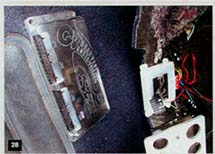
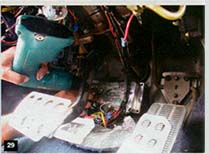
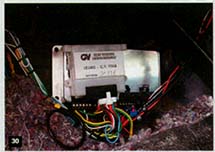
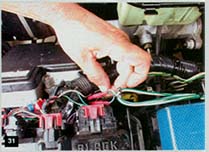
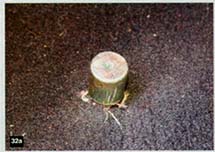
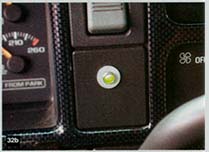
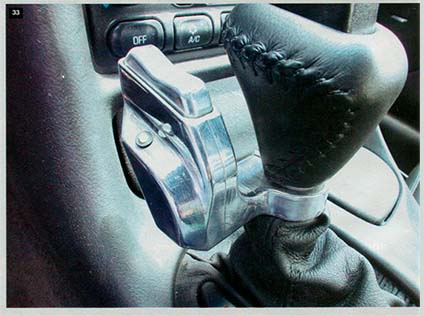
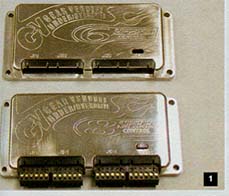
28 This is what the news is all about: The new GV electronics package. Where in the past the GV unit had to be manually manipulated, this box of tricks will do the footwork for you.29 To protect the electronics, the box is bolted to the firewall.30 With the unit affixed to the wall, the buffer is shown. It is the buffer that controls the AutoOut system. 31 The leads are actually not that difficult to wire up. Gear Vendors provides directions on which wire to tap into and where they can be found. In the case of this Chevy, there are actually four plugs that enter the computer, and it is not hard to find the wire that you need.32A-B As the Chevy does not have a floor shifter, a foot switch will be used to engage and disengage the Gear Vendors system. A small LED is placed into the dash. When it glows green, the unit is engaged. 33 For those of you who have a floor shifter, Gear Vendors has this trick thumb switch to engage the unit. This particular one is attached to the gear selector in GV owner Rick Johnson’s Corvette. This type of switch’s indicator light glows green when engaged, and turns red when not.
Thanks to the Gear Vendors Under/Overdrive, this loss of rpm can now be corrected, and thanks to the new AutoOut electronics, finding that lost rpm has never been easier. And for those who would like to add even greater flexibility, a new lower rear gear can be added for even greater acceleration, and then kick-in the Gear Vendors for those long highway jaunts. They have just made this Gear Vendors unit so flexible that we think of the unit as more OEM that aftemarket. By that we mean if we have a new vehicle, one of the very first items we’d add to it is a Gear Vendors Under/Overdrive-it makes that much sense. Now, the reasons are even greater to consider one. TB
Source
Gear Vendors
Dept. TB
1717 N. Magnolia Ave.
El Cajon, CA 92020
(800) 999-9555
www.gearvendors.com