Reprint from RV Live A Lifestyle Magazine, October 2000
Our RVs today are powered by the most sophisticated and powerful engines ever built and we’re running them at higher speeds while driving the biggest, heaviest and most complete RVs in history. All of which means there has never been a greater demand for Gear Vendors Under/Overdrive auxiliary transmissions.
Whoa!
An overdrive for your vehicle that already has overdrive. Think that doesn’t make sense?
It does. In fact, it goes right to the root of the problem.
One difficulty with those sophisticated engines in today’s motorhomes and tow vehicles is CAFÉ. That’s not a drink, it’s a governmental control on all automotive manufacturers: Corporate Average Fuel Economy.
Every manufacturer has to meet requirements of fuel economy over their entire product line. And with big engine trucks, SUVs and RVs the most popular with the public, fuel economy becomes a difficult problem. Manufacturers solve that problem through gearing. The newest transmissions have lockup torque converters to keep the RPMs lower after each shift. This is fine on an empty half-ton pickup that’s going through the EPA test course, but not near what you want if you are towing 10,000 lbs. Or more or have a motorhome that is always heavy. Yet you get the same transmission as the EPA-certified light duty truck.
And that creates a problem for us RVers, which Gear Vendors Under/Overdrive resolves through corrective gearing, called gear-splitting.
Let’s consider a specific transmission. The E4OD/4R100 is Ford’s heavy duty transmission used in heavier half-tons and all three-quarter and one ton trucks and motorhome chassis. It is a four-speed transmission, including overdrive. The 4.10 rear-end is one of the most common differential gears, pretty standard for towing and motorhome loads. When you buy a GEAR VENDORS, you get gears, so let’s look at a common set-up with 4.10 gear as an example. The ratios of this transmission are very similar to those found in the GM and Dodge products as well, and they all use a lockup torque converter:
First gear has a final drive ratio of 11.11, meaning the engine turns over 11.11 times for every full turn of the wheels. That’s powerful. Very powerful. Pretty hard to imagine a situation in which you could need to go lower, certainly not often.
Second gear has a final drive ratio of 6.31. Third gear has a final drive ratio of 4.10 and 4th or overdrive has a final drive ratio of 2.91.
Those are huge gaps between the gears and each shift means a major change in engine speed. An engine speed has everything to do with power.
Ford’s popular 6.8 liter V-10 engine develops 265 HP at 4,250 RPMs.
Revving the engine in first gear to that speed and shifting to 2nd drops the RPMs to 2,422 (53%). At this RPM, the engine produces only 175 HP. Besides a huge loss of 90 HP, you also have reduced the engine’s torque multiplication from 11.11 to only 6.31. You lose all this because it is such a large step from one gear to the next.
If you could keep the RPMs up and reach a gear in between those two, your power would obviously remain high. In fact, with a GEAR VENDORS Under/Overdrive 1st over produces a ratio of 8.67 (only a 22% change), which would put engine ROM at 3,314 and 250 HP. That’s 75 more ponies without any modification to the stock engine. What’s more, most of us don’t care to rev to 4,250 before we shift anyway, and GEAR VENDORS is then even more important.
And that’s what Gear Vendors does throughout the gears: It gives you a gear just about halfway between the stock gears. So shifting up or down; you don’t have as large a gap. RPMs remain high and so does the horsepower.
With the installation of a GEAR VENDORS Under/Overdrive, you’ll have eight forward gears. You’ll be doing exactly what the 18-wheelers are doing, using gears to keep up the RPMs and the resulting horsepower when you are tacking the hills, and using the low RPM torque when cruising on the flat highway. The more gears you’ve got, the easier it is to find the performance and economy originally designed into the motor.
Page Two
And, you won’t have a mechanic tinkering with the sophisticated computerized settings of that fine V-10. You’ll use the engine the way it was designed for-maximum longevity.
There are other pluses to the Gear Vendors.
That factory overdrive with the final drive ratio of 2.91 is very tall. If you try to run in it with a load, you will find it automatically shifting back and forth from third to overdrive in response to slight changes of elevation or wind resistance. This “hunting” is poison to transmission life.
With Gear Vendors installed, you can turn off the factory overdrive and use the positively engaged GV overdrive. It will not “hunt.” You will decide if an when to take it to the lower gear, or, if set on automatic, the RV will shift down when RPMs reach the necessary level.
And What about running empty with that tow vehicle? Tired of terrible mileage? With today’s greatly increased highway speeds, it is possible to go into double overdrive and have that engine barely turning over as you cruise down the highway at 65, 70 or 80 mph. The GEAR VENDORS Under/Overdrive is widely respected in the automotive industry, having been standard on a variety of vehicles right from the factory. It is used in racing vehicles: stock cars, off-roaders, land speed runners, dragsters and more.
Now that we know we need it, what is GV all about?
You’ve seen the ads for all sorts of auxiliary transmissions, but if you have
an automatic, you should note that only GEAR VENDORS offers a true GEAR SPLITTER; other products are either underdrives or overdrives. You need more power? You buy an underdrive. You run a gear lower than stock, but with the same wide gaps between the gears that rob you of performance output.
Same if you buy just an overdrive. It keeps you one gear over stock, but again with the same gaps that steal power.
With GEAR VENDORS Under/Overdrive, you have a sophisticated high-tech overdrive transmission that allows you to actually split between each gear and use the stock gears as well. And you can shift it under full power without loss of speed.
As a matter of fact, the GV is the only auxiliary transmission that has ever been used as standard original equipment on RVs, trucks or cars. They have been factory equipment on Fleetwood’s Limited and many other motorhomes and on GM’s ultra-custom Callaway Corvette.
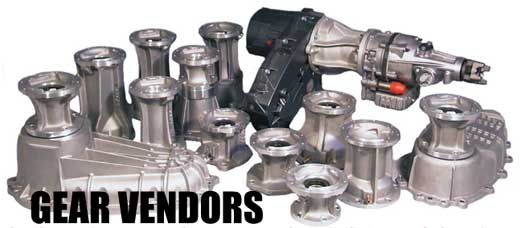
While GV has a unique design for almost every application imaginable, there is a similarity. They are all built much like an automatic transmission with high quality, close tolerance planetary gears. It bolts directly to your existing transmission and connects to the drive shaft. It has highly sophisticated electronics that interact with today’s computerized vehicles to give more performance automatically.
In the cockpit, there is a small space-age designed control box and a control switch which is mounted either on the steering wheel or on the floor in the approximate position of the old-style dimmer switch. The control box allows the GV to be set automatic functioning, so you don’t have to give it a thought. You can also set it to manual to take full control of the shift between each gear for maximum efficiency.
It’s a bit on the costly side, but the best always costs a little more. We’re talking the $3,000 range here.
You’ll make it back in peace of mind on tough hauls and engine and transmission longevity, along with major fuel savings in unloaded situations.
I’ve used GV for years, dating back to my old Ford diesel F250 with the C6 three-speed automatic transmission.
I went from crawling up freeway grades to sailing up them at highway speeds in 2nd over. And I went from an RVer ready to junk his truck to a happy camper.
For detailed and specific information on your application, study the GV web site at www.gearvendors.com, or call the factory direct for an informative brochure or real help from a real human: 1-800-999-9555.
Walt Miller is an RV’n On columnist in Lakeside, CA.